Aged Care vs. Nursing Home: Costs, Care & How to Pick
See real costs for aged care at home vs. a nursing home, plus the state programs that help pay for either one.
Clinically reviewed by Cottage Home Care's RN Care Coordination Team · Last reviewed OCT 2025 · Sources cited throughout, see the list at the end
If you're reading this at midnight after a phone call from the hospital, or after watching your father get up too slowly for the third time this week — you're not overreacting, and you're not alone. Most families start this search in the middle of a hard moment, not before one. That's normal, and it doesn't mean you've waited too long to get this right.
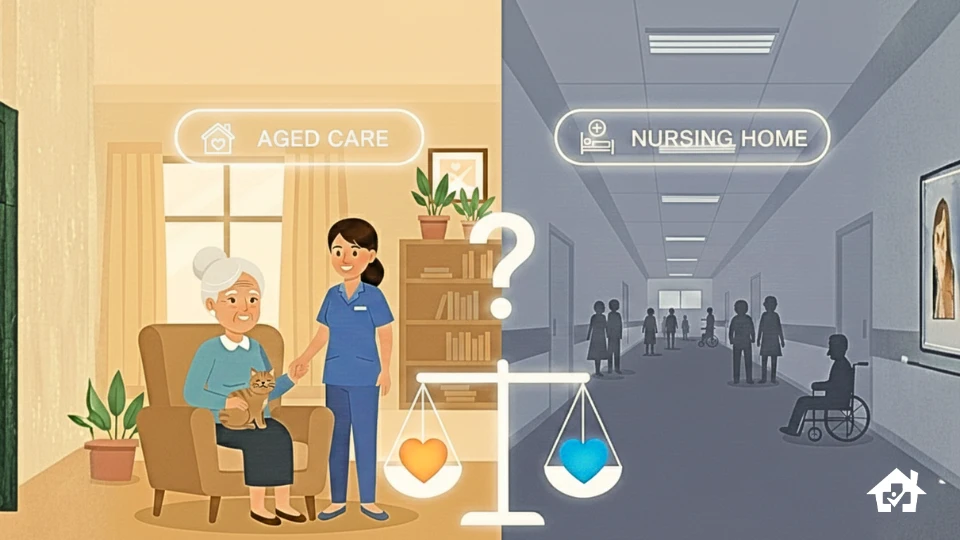
If you're searching “aged care vs nursing home,” you've probably hit a confusing mix of answers, too. In Australia and the UK, “aged care” is the umbrella term that includes nursing homes. In the U.S., where we work, “aged care” almost always means something different: care delivered at home, not in a facility. That mismatch is a real reason people end up more confused after searching than before they started.
We're Cottage Home Care Services. We've coordinated home care and facility transitions for families in New York, New Jersey, Maryland, and Michigan for more than 30 years. In this guide, we use the term the way U.S. families actually mean it: aged care as in-home support, nursing home as a licensed skilled nursing facility (SNF).
Here's what's ahead:
What's the Real Difference Between Aged Care and a Nursing Home?
Quick answer: Aged care (in-home care) lets a senior stay in their own home with help from a caregiver, on a schedule from a few hours a week to 24/7. A nursing home is a licensed skilled nursing facility (SNF) with round-the-clock nursing on-site, built for people who need constant medical supervision.
Aged care at home usually includes:
- A personal care aide (PCA) or home health aide (HHA) helping with ADLs — activities of daily living like bathing, dressing, and mobility — and IADLs, like meal prep, light housekeeping, and transportation
- Periodic visits from an RN or LPN for medication management, wound care, or fall-risk review
- Flexible hours, from a few visits a week to live-in care
- Funding through Medicaid waivers, long-term care insurance, or private pay
A nursing home usually includes:
- RNs, LPNs, and certified nursing assistants (CNAs) on-site 24/7
- Medication administration, wound care, and physical or occupational therapy built into daily routine
- A private or semi-private room in a licensed facility, with care plans reviewed by a case manager
- CMS oversight through the Minimum Data Set (MDS) assessment process and public quality reporting
Neither is automatically “better.” The right choice depends on how much medical supervision is actually needed and whether the home can be made safe enough to support it.
|
Aged Care (Home) |
Nursing Home (SNF) |
| Setting | Private home | Licensed facility, private/semi-private room |
| Staffing | PCA/HHA daily, RN/LPN visits | RNs and CNAs on-site 24/7 |
| Schedule | Flexible, built around the family | Fixed facility routine |
| Best for | Help with ADLs/IADLs, not constant medical care | Continuous nursing care or complex medical needs |
| Typical funding | Medicaid waivers, private pay, LTC insurance | Medicaid, Medicare (short stays only), private pay |
| Oversight | Care plan managed by agency RN | CMS 5-star rating via Care Compare |
Home Care vs. Nursing Home Cost: The Real Numbers
Quick answer: For most families, home care is cheaper up to roughly 40–44 hours a week. Past that, a nursing home's bundled monthly rate often becomes the better value, because it already includes housing, meals, and 24/7 staff.
What that hourly rate actually pays for
Families are usually quoted somewhere around $33–35 an hour for a home health aide. That number surprises people, because caregivers themselves aren't taking home anything close to it. According to the U.S. Bureau of Labor Statistics, wages for home health and personal care aides nationally ranged from about $12–21 an hour in 2025 data, depending on region and experience.
The gap between what a caregiver earns and what an agency bills covers real costs, not padding:
| Cost component | Approx. share of billed rate |
|---|
| Caregiver wages | 45–55% |
| Payroll taxes (FICA 7.65%, unemployment insurance) | ~8–10% |
| Benefits (workers' comp, liability insurance, PTO where offered) | ~10–15% |
| Supervision, scheduling, RN care plan oversight, background screening | ~10–15% |
| Agency overhead and margin | 10–20% |
What different care schedules cost per month
Based on a national hourly rate of $33–35:
| Hours per week | Monthly cost range | Notes |
|---|
| 20 (part-time) | $2,850–$3,050 | Common for early-stage support |
| 40 (standard full-time) | $5,700–$6,100 | Below most nursing home rates |
| 60 | $8,550–$9,100 | Approaching nursing home cost range |
| 84 (12 hrs/day) | $12,000–$12,750 | Often exceeds a semi-private nursing home room |
| 168 (24/7 live-in coverage) | $18,000–$25,000+ | Usually well above nursing home cost |
For comparison, CareScout's 2025 Cost of Care Survey (Genworth) puts the national median nursing home cost at $315–355/day, or about $9,600–$10,800/month, depending on whether the room is semi-private or private.
State variation is large. New York is consistently one of the most expensive states for nursing home care — industry surveys have put semi-private rates there well above $180,000 a year — which usually makes home care the better value for families who don't need round-the-clock supervision. In lower-cost states, the gap narrows, and high-hour home care can occasionally cost more than a facility room. Ask us for current numbers in your specific county; state medians move every year.
What you don't need to worry about
- You don't have to pick the priciest option to get good care. A 2019 study in JAMA Internal Medicine, analyzing more than 17 million Medicare hospitalizations, found that patients discharged to home health care cost Medicare about $4,514 less over 60 days than those discharged to a skilled nursing facility, with no meaningful difference in 30-day mortality.
- Owning a home doesn't disqualify a family from Medicaid home care. The primary residence is generally an exempt asset while the applicant or community spouse lives in it.
- A nursing home stay isn't always permanent. Medicare covers short-term rehab stays after a qualifying hospitalization, and many people return home with a home care plan afterward.
What Medicare and Medicaid Actually Cover
Quick answer: Medicare covers short-term skilled nursing after a qualifying hospital stay, with cost-sharing that increases sharply after day 20. Medicaid covers long-term nursing home care in every state and covers home care through state-specific waiver programs, each with its own income and asset rules.
Medicare's skilled nursing facility (SNF) benefit
- Requires a qualifying 3-day inpatient hospital stay immediately before SNF admission
- Days 1–20: covered in full, $0 daily coinsurance
- Days 21–100: daily coinsurance applies (a few hundred dollars a day, adjusted annually)
- Day 101 onward: Medicare pays nothing; the resident is private-pay or transitions to Medicaid if eligible
- Medicare does not cover long-term custodial care in either a nursing home or at home
Medicaid's long-term care rules (2026 federal figures)
- Individual asset limit: generally $2,000 in countable assets
- 5-year look-back: Medicaid reviews the prior 60 months of finances; uncompensated transfers or gifting in that window can trigger a penalty period that delays eligibility
- Community Spouse Resource Allowance (CSRA): when one spouse applies and the other stays home, the at-home spouse can keep between $32,532 and $162,660 in countable assets, depending on the state and the couple's total resources
- Minimum Monthly Maintenance Needs Allowance (MMNA): the at-home spouse is guaranteed between $2,643.75 and $4,066.50 a month in income
- These figures are federal minimums and maximums — your state sets its own number inside that range, so confirm the exact figure with your state Medicaid office or an elder law attorney before making financial decisions
State programs we coordinate with
- New York — MLTC and NHTD: Managed Long-Term Care and the Nursing Home Transition and Diversion waiver fund home-based care for people who'd otherwise need a nursing facility level of care.
- New Jersey — NJ FamilyCare: covers home- and community-based services for eligible applicants, alongside private pay HHA services.
- Maryland — Community First Choice (CFC): a state Medicaid option funding personal care and home-based supports.
- Michigan — MI Choice waiver and PACE: home- and community-based alternatives to nursing facility placement.
Not sure which programs you qualify for? A free nurse assessment tells you exactly what level of care is needed and which funding options apply — before you commit to either option. Call 516-367-2266 or email info@cottagehomecare.com.
When Does Home Care Stop Being Safe?
Quick answer: Home care generally stops being a safe option when a person needs continuous skilled medical intervention that can't be scheduled around visits, or when a two-person physical transfer is required for daily safety.
Use this as a starting checklist, not a diagnosis — a nurse assessment should confirm any of these before you make a final decision:
- Needs IV medications or ongoing intravenous therapy
- Has a complex wound (e.g., a wound VAC) requiring specialized dressing changes multiple times a day
- Needs a ventilator or has a tracheostomy requiring suctioning
- Requires two people for every transfer (bed to chair, chair to toilet)
- Has had frequent falls with injury despite home modifications
- Has an active infection requiring isolation precautions
- Needs supervision more consistent than a caregiver rotation can realistically provide (common in later-stage dementia)
Falls are worth taking seriously on their own. According to the CDC, more than 1 in 4 adults 65 and older — over 14 million people — fall each year, and about 37% of those falls cause an injury serious enough to need medical treatment or restrict activity. Falls are also the leading cause of hip fractures in this age group. If falls are becoming frequent, that's a strong signal to get a fall-risk assessment, not just add more caregiver hours.
If Your Parent Says No to Help
Quick answer: Don't argue the decision head-on. Propose a small, time-limited trial, and frame it as support for independence, not a loss of it.
Refusal is common, and it's rarely really about the caregiver. It's more often about fear — fear of losing independence, of being a burden, of what accepting help means about where things are headed. Getting angry back or pushing harder usually backfires.
A few things that tend to work better:
- Start smaller than you think you need to. “Can we try someone coming three times a week for a month, and then we'll talk about whether it's helping?” is easier to say yes to than an open-ended commitment.
- Reframe around what they keep, not what they lose. “I want you to have help so you can stay in your own home safely” lands differently than “You need someone watching you.”
- Loop in someone they trust who isn't you. A doctor, a longtime friend, or a faith leader raising the same concern often carries more weight than a family member saying it again.
- Use a scheduled medical appointment as a natural checkpoint. Asking a physician to raise home safety directly can depersonalize the conversation.
- Watch for signs it's not just stubbornness. Difficulty recognizing the need for help can sometimes be part of a cognitive change, not just personality. If that seems possible, it's worth mentioning to their doctor directly.
There's no script that works every time, and it's okay if the first attempt doesn't land. Most families need more than one conversation.
Common Mistakes Families Make
Quick answer: The two most common mistakes are waiting for a crisis to start comparing options, and choosing based on price alone without a nurse assessment first.
- Waiting until an ER visit forces the decision. Starting early leaves room to trial home care, apply for waivers, and adjust — instead of deciding from a hospital waiting room.
- Assuming Medicaid rules are the same for home care and nursing homes. They're not. Waiver programs and nursing home Medicaid have different applications, asset rules, and, in some states, waitlists.
- Picking based on price without a nurse assessment. The cheapest option on paper can get expensive fast if it doesn't actually cover what's needed — fall prevention after a recent injury, for example, or medication management for a new diagnosis.
- Not planning to reassess. Needs change. A plan that fits today may not fit in six months, especially after a health event.
- Confusing U.S. “aged care” with the international meaning. A source that treats aged care and nursing homes as identical was very likely written for an Australian or UK audience, not a U.S. one.
Choosing and Vetting a Home Care Agency
Quick answer: Verify licensing, screening, and insurance before anything else — reputation and reviews matter, but they can't substitute for confirming an agency actually meets the legal minimum.
Before signing with any agency, ask for or confirm:
- State home care license number, verified directly with your state's licensing board
- Background check scope — state and, ideally, federal, not just a county-level check
- OIG exclusion list screening for every caregiver, confirming they're not barred from federal health programs
- Certifications on file for CNAs/HHAs, plus CPR certification
- TB test and immunization records kept current
- Liability and malpractice insurance limits, with a certificate of insurance available on request
- Caregiver turnover rate — a high published turnover rate is a real signal of inconsistent care
- A written service agreement covering cancellation policy, overtime billing, and travel or trip charges, so nothing is a surprise on the first invoice
Your Step-by-Step Decision Checklist
Quick answer: Start with a needs assessment, not a facility tour. Care level, not preference, should drive the decision.
- List the daily needs. Bathing, dressing, meals, mobility, medication — what does your loved one actually need help with right now?
- Get a free nurse assessment. This gives an objective read on care level, not a sales pitch for one option over another.
- Check home safety. Can the home be modified with grab bars, ramps, or a stairlift, or does the layout make in-home care unsafe?
- Confirm funding. Compare Medicaid waivers (MLTC, NHTD, CFC, MI Choice), long-term care insurance, and private pay rates side by side.
- Vet any agency before signing. Use the checklist above — license, screening, insurance, turnover.
- Trial before committing long-term. Start with a set number of home care hours per week before locking into a bigger package.
- Set a reassessment date. Revisit the plan every 3–6 months, or immediately after any fall, hospitalization, or diagnosis change.
- Talk it through as a family. The person receiving care should have a voice in the decision whenever possible.
Two Families, Two Paths
The following are illustrative composites based on common patterns we see, not real client records.
The urgent path
A fall sends a parent to the ER. The family has days, not weeks, to decide. They start with a short-term home care plan while applying for a Medicaid waiver, using the trial period to figure out whether home is realistically safe long-term. Within a few months, they either scale up home care or transition to a nursing facility with much less panic than the first decision required.
The planned path
A family notices small changes — missed medications, a messier house than usual — well before any emergency. They request a nurse assessment early, start with a few hours a week, and build funding eligibility over time. When needs increase later, the transition to more hours, or eventually a facility, is a scheduled step instead of a scramble.
Neither path is more “responsible” than the other. Most families end up in the urgent path simply because that's how the need showed up.
Frequently Asked Questions
What's the main difference between aged care and a nursing home?+
Aged care supports someone living independently at home with part-time or full-time help. A nursing home provides 24/7 skilled nursing in a licensed facility.
How much does home care cost per hour?+
Nationally, families are typically billed around $33–35 an hour, which covers the caregiver's wage plus payroll taxes, insurance, and agency oversight. Rates vary by state and by whether care is scheduled during standard hours, overnight, or on short notice.
Will Medicare pay for home care after surgery?+
Medicare may cover short-term skilled nursing or home health services if a physician certifies the need and Medicare's requirements are met, including, for facility-based SNF care, a qualifying 3-day hospital stay. Coverage is time-limited, not ongoing custodial care.
Can Medicaid pay for home care instead of a nursing home?+
Yes, in most states, through a Medicaid waiver or managed long-term care program. Rules, waitlists, and asset limits vary by state — contact your state Medicaid office or local Area Agency on Aging for specifics.
Is home care cheaper than a nursing home at 24/7 care?+
Usually not. Once care approaches round-the-clock coverage, a semi-private nursing home room is often less expensive on a monthly basis, because the facility rate already bundles housing, meals, and staffing.
My parent refuses home care. What do I do?+
Try a small, time-limited trial rather than an open-ended ask, involve a doctor or trusted third party in the conversation, and revisit it more than once. See the “If Your Parent Says No to Help” section above for specific approaches.
Can family members get paid to provide care?+
In some states, certain Medicaid waiver programs allow a family member to become a paid, employed caregiver. Eligibility and pay rates depend on the specific state program, and this isn't a service we coordinate directly — ask us which funding options we do work with for your situation.
How often should we reassess a care plan?+
Every 3 to 6 months, or right after any fall, hospital stay, or new diagnosis.
Local Help Beyond Us
Making the Decision With Support, Not Guesswork
Aged care vs. nursing home isn't usually a one-time choice — it's a decision most families revisit as needs change. What matters most is matching the care level to the actual medical need, with real numbers in hand, not a price tag or a facility's marketing.
If you want a real answer for your specific situation, a free nurse assessment from Cottage Home Care will tell you what level of care fits and which funding programs apply in New York, New Jersey, Maryland, or Michigan.
Call 516-367-2266
Email Us
Related reading:
Private Pay Home Care Rates ·
Nursing Home Transition and Diversion (NHTD) ·
HHA Job Requirements
|
|


 Sabine DurgaramDPS/RN