Key Takeaways
- CNA: A Certified Nursing Assistant helps patients with everyday needs such as bathing, eating, and moving safely.
- CMA: A Certified Medical Assistant usually helps in a doctor's office or clinic with patient visits and office tasks.
- Pay: The U.S. median annual wage was $42,260 for nursing assistants and $45,690 for medical assistants in May 2025.
- Training: CNA training is often shorter. Medical assisting education often takes longer, and the path to certification depends on the credential.
- Best choice: Pick CNA for hands-on daily care or CMA for clinic-based medical and office work. Neither job is automatically higher than the other.
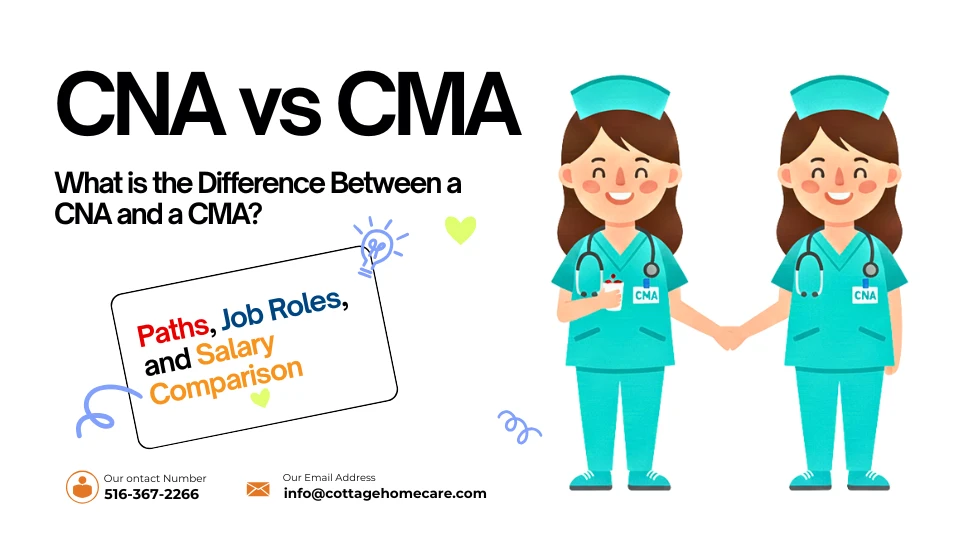
The main difference between a CNA and a CMA is the kind of help they give patients. A CNA often spends much of the day helping people with basic care. A CMA often works with a medical team during clinic visits and helps keep the office running.
Both careers can be a good start in healthcare. But the training, pay, work hours, and daily tasks are not the same. This guide uses current U.S. job data so you can compare your options before choosing a program or applying for work.
In This Guide
CNA vs CMA: Quick Comparison
Here is the difference between a Certified Nursing Assistant and a Certified Medical Assistant in one place.
| Feature |
CNA |
CMA |
| Full name | Certified Nursing Assistant | Certified Medical Assistant |
|---|
| Main work | Daily hands-on care | Clinic care and office tasks |
|---|
| Common setting | Nursing homes and hospitals | Doctor's offices and clinics |
|---|
| Training | Often 4–12 weeks, plus a state exam | Often a certificate or degree program; exam eligibility depends on the credential |
|---|
| 2025 median pay | $42,260 per year | $45,690 per year |
|---|
| Best fit | You enjoy helping with daily personal care | You enjoy clinic work and staying organized |
|---|
Pay figures are U.S. national medians from the Bureau of Labor Statistics (BLS), May 2025. BLS counts all medical assistants in its pay data, not just workers with the CMA (AAMA) credential.
What Does a CNA Do Compared With a CMA?
What does a CNA do?
A CNA helps people with daily care under the direction of a licensed nurse. These tasks are often called activities of daily living, or ADLs. A CNA may help an older adult get dressed, eat a meal, or move from a bed to a chair.
- Help with bathing, dressing, toileting, and meals.
- Help patients walk, turn, or move safely.
- Check basic vital signs as assigned.
- Notice changes and tell the nurse.
- Keep patients comfortable and support their dignity.
CNAs do not diagnose health problems or make treatment plans. Their close contact with patients helps the nursing team notice when someone needs extra attention.
What does a CMA do?
A Certified Medical Assistant often works in a clinic or doctor's office. A CMA may help before, during, and after a patient visit. The role may include both patient care and office work.
- Check vital signs and record health information.
- Prepare patients and rooms for an exam.
- Schedule visits and update medical records.
- Help with lab samples or EKG tests when trained and permitted.
- Help with approved clinical tasks under the required supervision.
Some medical assistants give injections, but only when their training, state law, and supervising provider allow it. Medical assistants do not prescribe medicine or make a diagnosis.
CNA vs CMA Salary: Which Pays More?
Medical assistants had a higher national median wage than nursing assistants in May 2025. The difference was $3,430 per year. That does not mean every CMA job pays more than every CNA job.
Nursing assistant (CNA)
$42,260
Median annual wage, May 2025
Medical assistant (CMA career field)
$45,690
Median annual wage, May 2025
A median is the middle wage: half of workers earn more and half earn less. The BLS figures cover workers across the United States. Your pay may change with your state, work setting, experience, hours, and employer.
Before taking a job, ask about the hourly rate, paid training, overtime, weekend shifts, and benefits. Compare the actual offer, not just the national average.
CNA vs CMA Training and Certification
How to become a CNA
A common path is to complete a state-approved nurse aide course and pass the state's skills and knowledge tests. The Centers for Medicare & Medicaid Services (CMS) says nursing home CNA training often lasts 4 to 12 weeks.
- Find a state-approved CNA training program.
- Complete classroom lessons and hands-on practice.
- Pass your state's required competency test.
- Meet the state's registry and renewal rules.
Some nursing homes may cover approved CNA training or offer reimbursement for eligible workers. Ask the employer about the program before paying for a course.
How to become a CMA
Many medical assistants complete a certificate or associate degree program. Some enter the field through job training. But if you want the CMA (AAMA) credential, you must meet that certification program's exam rules.
- Choose the medical assistant job and credential you want.
- Check whether the program meets the exam's eligibility rules.
- Complete the needed classes and practical training.
- Apply for and pass the certification exam if you qualify.
The American Association of Medical Assistants (AAMA) accepts graduates of certain accredited programs and also has other exam eligibility paths. The CMA (AAMA) credential must be renewed every 60 months, through continuing education or an exam.
Before you enroll, ask these 4 questions
- Does the program meet the credential's exam rules?
- What is the full cost, including tests and supplies?
- Is hands-on training included?
- Will the credential meet local employer needs?
What Is a Typical CNA or CMA Workday Like?
A CNA's day
A CNA in a nursing home may start by helping residents get ready for the day. That can mean washing up, getting dressed, eating breakfast, and moving safely. Later, the CNA may record vital signs, help with meals, and report changes to a nurse. The work is active and often involves lifting or moving patients with proper help and equipment.
A CMA's day
A CMA in a doctor's office may prepare exam rooms, bring patients in, check vital signs, and update charts. Between visits, the CMA may help book appointments or handle records. Some clinics also assign lab or other approved clinical tasks. The mix depends on the office and the worker's training.
Workplaces and Work Hours
CNA workplaces: Nursing homes, hospitals, rehabilitation settings, and some home care roles. Because care is needed all day and night, many CNA jobs include evening, night, weekend, or holiday shifts.
CMA workplaces: Doctor's offices, outpatient clinics, and other medical settings. Some jobs follow clinic hours, while others include evenings or weekends.
If you need work hours that fit school or family duties, ask employers about the exact shift before you apply. No one schedule fits every CNA or CMA job.
CNA vs CMA Job Growth and Career Paths
The BLS projects employment to grow 3% for nursing assistants and 13% for medical assistants from 2025 to 2035. These are national job forecasts, not promises of openings in your town.
After CNA work: With more schooling and the right license, you may work toward becoming a licensed practical nurse (LPN) or registered nurse (RN). Some CNAs also train for lead aide or medication aide roles.
After medical assisting: With experience or more training, you may move toward clinic support, a medical specialty, or office leadership. A nursing job still requires its own nursing education and license.
Does CMA Mean Medical Assistant or Medication Aide?
CMA can mean two different healthcare credentials. This article compares a CNA with a Certified Medical Assistant, whose work is usually based in a clinic.
In some states, CMA also means Certified Medication Aide. That worker helps give certain medicines in approved care settings after special training. It is a different role. For example, Oklahoma has a medication aide credential with its own entry rules for qualified nurse aides.
If a job ad says “CMA,” read the full job title and duties before applying. A clinic medical assistant job and a nursing home medication aide job are not the same career path.
Can a CNA Become a CMA?
Yes, a CNA can train to become a Certified Medical Assistant. Your CNA experience may help you feel at ease with patients. But CNA status alone does not grant the CMA (AAMA) credential or make you eligible for every CMA exam.
First, check the requirements of the medical assisting program and certification you want. Then ask which of your past classes, if any, will count toward that program.
The reverse is also true: being a Certified Medical Assistant does not automatically give you state CNA status. To work in a CNA role that requires certification, you must meet that state's nurse aide rules.
Which Career Is Better for You: CNA or CMA?
Neither career is better for everyone. Think about the work you enjoy, how soon you want to begin, and what jobs are open near you.
CNA may fit if you...
- Enjoy hands-on daily care.
- Want a shorter common training path.
- Are comfortable with active work and patient care shifts.
CMA may fit if you...
- Like clinics and patient visits.
- Enjoy both clinical and office tasks.
- Are ready to check a longer training and exam path.
Before choosing, look at 3 local job posts for each role. Check the pay, shifts, required certificate, and travel time. A job that fits your daily life may be the better choice even if its national median pay is lower.
If you are comparing care options for a parent rather than planning your own career, the more useful question may be what kind of daily help your parent needs. Cottage also explains the difference between a caregiver and a CNA.
Looking for Caregiving Work or Help at Home?
Cottage Home Care lists caregiver openings in several states. You can review the location, role, and needed training on the Cottage careers page. Pay and hiring needs depend on the open position. Not every listing is a CMA job.
If your family needs help with bathing, dressing, meals, or other daily tasks at home, our team can discuss the care needed, your location, and possible service and payment options. You can contact Cottage Home Care to ask what information to prepare. Care programs and any paid family-caregiver option depend on state rules and eligibility.
CNA vs CMA: Frequently Asked Questions
What is the biggest difference between a CNA and a CMA?+
A CNA mainly helps people with daily personal care. A Certified Medical Assistant mainly helps with patient visits and office tasks in a clinic.
Does a CNA or CMA earn more?+
Medical assistants had a higher U.S. median annual wage in May 2025: $45,690, compared with $42,260 for nursing assistants. Actual pay depends on the job and location. BLS medical assistant pay includes both certified and noncertified workers.
Is a CMA higher than a CNA?+
No. They are different jobs, not two levels of the same job. Medical assistants often have more office and clinic duties, while CNAs focus on hands-on daily care.
Which is faster to become, CNA or CMA?+
CNA training is often faster. CMS says nursing home CNA courses commonly take 4 to 12 weeks. Medical assisting programs may take longer. Always check the training and exam rules before you enroll.
Can a CNA become a CMA without more training?+
CNA experience can help, but it does not replace the eligibility rules for the CMA (AAMA) exam. Check the program you want to attend and ask whether any prior classes count.
Can a medical assistant work as a CNA?+
A medical assistant credential does not automatically qualify you for a CNA job that requires state certification. You must meet the nurse aide requirements for that state and position.
Can CMAs give injections or medications?+
Some Certified Medical Assistants may give certain injections when trained and allowed under state law and clinical supervision. A Certified Medication Aide is a different role with separate rules.
Does Cottage Home Care hire CNAs or CMAs?+
Cottage posts open caregiver and support roles on its careers page, including some CNA-related positions. Available jobs and credential needs depend on the state and current openings. Check the listings for the role you want.
The Bottom Line
If you like helping people with daily care and want a shorter common path into patient support, a CNA role may fit you. If you enjoy medical offices, patient visits, and organized records, a CMA role may be the better match. Compare real local job openings and check training rules before you choose.

 Alex TullaoRegistered Nurse