Careers & Certification Guide
PCA Certification: How to Get Certified in Your State (2026)
Search “PCA certification requirements” and you'll get a different answer on every page: 40 hours, 75 hours, 120 hours, no hours at all. None of those pages is lying to you. They're just each describing one state, and none of them says which one.
That's the actual problem with PCA certification: it isn't one thing. There's no federal PCA license, no single national exam, no universal hour count. What counts as “certified” in Michigan doesn't exist as a category in Texas. A rule that's mandatory in New York is optional in Maryland.
This guide sorts that out: what PCA certification actually means, the real training-hour requirement in every state Cottage Home Care operates in, what a PCA does differently from an HHA or CNA, the mistakes that trip people up, and a state-by-state action plan you can start today.
In This Guide
What Is PCA Certification?
Quick Answer
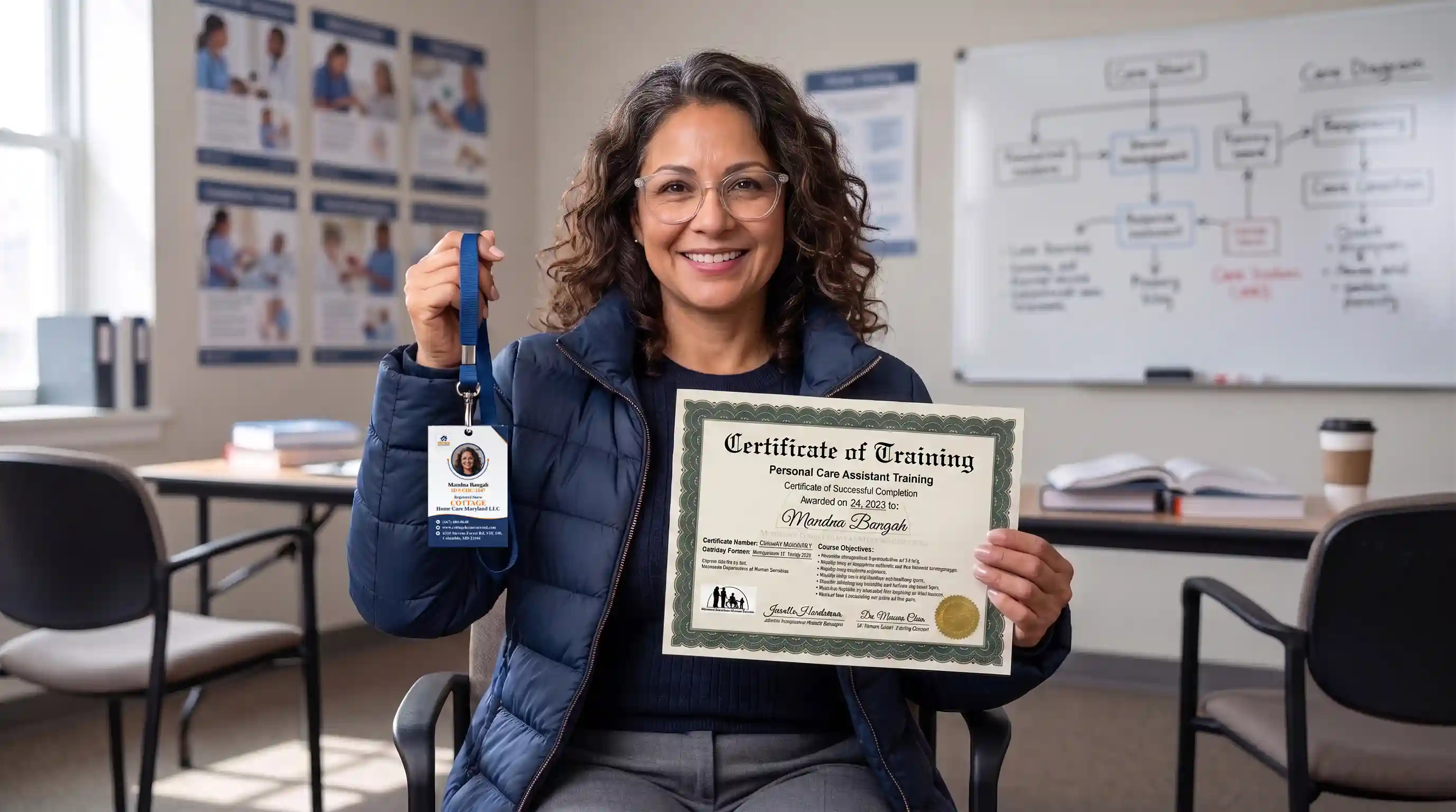
PCA certification is proof you've completed whatever training your state requires to work as a paid Personal Care Aide. There's no federal standard for it. Every state sets its own rule, so the hours, the exam, and even whether a certificate exists at all changes depending on where you live. Some states mandate 40+ hours of training. Eleven of the 23 states Cottage Home Care serves require none.
A Personal Care Aide (PCA) helps people with the things they can no longer safely do alone: bathing, dressing, moving around the house, cooking, light housekeeping. It's non-medical work. The U.S. Bureau of Labor Statistics draws the line clearly: personal care aides are “generally limited to providing nonmedical services,” while home health aides can take on basic health-related tasks (checking a pulse, helping with medication) once a nurse has signed off on it.
That line matters, because it's the reason requirements vary so much. States that fold PCA duties into a health-related role (like an HHA) tend to require the federal 75-hour floor. States that treat PCA work as purely non-medical support often set no hour requirement at all. They rely on a competency check, an agency orientation, or nothing beyond a background check.
One mix-up worth clearing up
“PCA” doesn't always mean the same job
Some training listings that turn up under “PCA certification” aren't about home care at all. A few community colleges run a “Patient Care Associate” program: a hospital-based, multi-skill technician role that bundles CPR, medical terminology, EKG, phlebotomy, and CNA coursework, often for $4,000+. That's a different job with a different price tag. If you're looking to become a home-based Personal Care Aide, you don't need any of that.
PCA vs. HHA vs. CNA
People searching “PCA certification” often really want to know how it stacks up against the other titles on a job posting. Here's the actual difference:
| Personal Care Aide (PCA) | Home Health Aide (HHA) | Certified Nursing Assistant (CNA) |
|---|
| What they do | Non-medical daily living support: bathing, dressing, meals, mobility, light housekeeping | PCA duties plus basic health tasks (vitals, medication reminders) under a nurse’s care plan | Hands-on clinical care under direct nurse supervision |
| Typical setting | Private homes | Private homes, Medicare/Medicaid-certified agencies | Nursing homes, hospitals, rehab facilities |
| Federal training floor | None – state-set only | 75 hours for Medicare-certified agencies (42 CFR §484.80) | 75 hours (federal nurse aide minimum) |
| Hours in Cottage’s 23 states | 0–76 hours, state-dependent | Generally 75 hours | Generally 75–130 hours plus a state exam |
| State registry | Depends on the state | Yes, in most states | Yes, nationwide nurse aide registries |
Neither role is “better.” They're different jobs with different scopes. A PCA who wants to eventually give medications or check vitals typically moves up to HHA or CNA, which is why some job ads use the titles almost interchangeably even though the training isn't.
Cottage Home Care has run in-home care since 1992 and is currently licensed across 23 states, so this isn't theoretical for us: we hire into all three roles and see the state-by-state differences firsthand.
How to Get Certified: Steps by State
Quick Answer
Check your state's specific rule first, since that determines everything else. Then enroll in an approved (or state-run) training program, complete the required hours if your state has any, pass a competency check if one applies, and register or apply for your certificate. Some states finish this in an afternoon. Others take six to eight weeks.
The general process
- Look up your state's rule. Search “[your state] Medicaid personal care aide training” or check the table below.
- Pick an approved program. Many states publish an official list. Home care agencies (including Cottage Home Care in several states) also run or sponsor free training tied to future employment.
- Complete the training. Where hours are required, they typically split between classroom instruction and hands-on skills practice.
- Pass the competency check, if required. Most states use a written test, a skills demonstration, or both. A background check is standard almost everywhere.
- Register or apply for your certificate. In states with a centralized registry, your training provider submits your completion for you.
- Renew on schedule, if your state requires it. Continuing education ranges from zero to about 12 hours a year.
PCA training requirements, state by state
This is the piece most articles skip. Requirements below are for agency-based PCAs working through a state Medicaid program, the most common path. Private-pay and consumer-directed (self-hired) arrangements sometimes follow different, lighter rules, so always confirm current requirements with your state's Medicaid or health department.
| State | Training Hours Required | Notes |
|---|
| New York | 40 hours (within 90 days) | State curriculum, competency exam, centralized registry |
| New Jersey | 76 hours (60 classroom + 16 clinical) | Certified Homemaker–Home Health Aide credential; registry |
| Virginia | 40 hours | State curriculum (DMAS); 12 hrs/year continuing education |
| Georgia | 40 hours | RN-taught; 8 hrs/year continuing education |
| Massachusetts | 60 hours (Medicaid) / 4 hours (consumer-directed) | State curriculum; competency exam for the 60-hour track |
| Maine | 50 hours (within 6 months of hire) | “Personal Support Specialist” credential; registry |
| North Carolina | 0 hours (Level II) / 75 hours (Level III, Medicaid) | Level III converts to a CNA credential |
| Ohio | 30 hours (ODA-certified) | Competency exam; HHA/CNA can substitute |
| Illinois | 10–24 hours, depending on program | Higher end applies to the Medicaid Community Care Program |
| Missouri | 12 hours (6 before first client) | Competency exam; 5 hrs/year continuing education |
| California | 8–10 hours | Registry (Home Care Aide) for agency-affiliated workers |
| Michigan | 0 hours | Home Help Program; competency-based, no state license |
| Maryland | 0 hours | No state-mandated PCA training hours |
| Connecticut | 0 hours | Standardized state curriculum + competency exam, but no hour minimum |
| Arizona | 0 hours | State curriculum (“Principles of Caregiving”) + competency exam |
| Pennsylvania | 0 hours | Competency exam required; hours left to the agency |
| South Carolina | 0 hours | Competency exam; 10 hrs/year continuing education |
| Kentucky | 0 hours | State curriculum + competency exam; annual renewal training |
| New Hampshire | 0 hours | No hour, exam, or renewal mandate specified |
| Indiana | 0 hours | No PCA training requirement in any Medicaid program |
| Tennessee | 0 hours | No PCA training requirement in any Medicaid program |
| Colorado | 0 hours | Medicaid track only; private-pay agencies set their own (often ~20 hrs) |
| Florida | 40 hours | Folded into the HHA credential; RN-taught; registry |
Sources: state Medicaid agencies and departments of health; PHI National’s 50-state PCA training survey (2025); New York State Department of Health.
Eleven of those 23 states (bolded above) have no fixed hour requirement for a Medicaid-funded PCA. That's the detail most “PCA certification” guides get wrong when they quote a single 40-to-75-hour range as if it applied everywhere.
What NOT to do
- Don't assume your state matches a friend's. Training hours in Cottage's own footprint range from 0 to 76.
- Don't pay for a “national PCA certification.” There isn't one. A credential your state registry doesn't recognize won't help you get hired or get paid through Medicaid.
- Don't skip verifying a program is state-approved before you enroll or pay, especially for online courses advertising “PCA certification” with no state name attached.
- Don't confuse this with the hospital “Patient Care Associate” program described above. Different job, different training, different cost.
Mistakes to Avoid + What’s New for 2026
Quick Answer
The most common mistake is trusting a single “PCA training takes 40 to 75 hours” figure, which is accurate for some states and flat wrong for others. On the demand side, 2026 brings no change to the patchwork of state rules, but it does bring continued strong hiring: the Bureau of Labor Statistics projects 17% job growth for home health and personal care aides from 2024 to 2034, among the fastest of any occupation.
Where most guides go wrong
- Treating “PCA” as one national credential. Nationally, PHI National's research found 26 states set some kind of hour minimum for Medicaid-funded PCAs; the rest don't, or leave it up to the agency.
- Quoting one hour range for the whole country. A guide that says “PCA training is 40–75 hours” is describing maybe half the country accurately and misleading the other half.
- Skipping the Medicaid-vs-private-pay distinction. The same state can require real hours for Medicaid-funded agency work and nothing at all for private-pay or self-directed care.
- Citing outdated growth numbers. Older PCA articles still quote 25–30% job growth from 2020–2031 projections. The current federal figure, based on 2024–2034 data, is 17%, still much faster than average, with about 765,800 openings projected per year.
What’s actually changing in 2026
Demand keeps climbing regardless of the training patchwork. The BLS attributes it to a straightforward shift: long-term care is moving out of institutions and into people's homes. Median pay for the occupation was $34,900 a year (about $16.78/hour) as of May 2024, with the top 10% earning over $44,000.
Your Action Plan
- Confirm your state's rule today. Use the table above, then verify on your state Medicaid or health department site.
- Decide Medicaid-agency vs. private-pay. This changes which training rule actually applies to you.
- Find an approved program. Many home care agencies, including Cottage Home Care in several states, offer training tied directly to a job offer, often at no cost.
- Complete training and any required exam. Block out the time upfront: a few hours to about eight weeks, depending on your state.
- Apply for work. In states with no formal hour requirement, a completed background check and orientation are often enough to start.
- Calendar your renewal date, if your state requires continuing education.
Quick win
If your state is one of the eleven with no fixed hour requirement, the fastest path in is usually a home care agency's own paid orientation. You can often start earning while you complete it instead of paying for a course first.
Frequently Asked Questions
What is a PCA certificate?+
It’s proof you’ve completed the training (or competency check) your state requires to be paid as a Personal Care Aide. Some states require 40+ hours and an exam; others just a background check and employer orientation.
Who needs PCA certification?+
Anyone working as a PCA through a state Medicaid program in a state that mandates training: 12 of the 23 states in Cottage’s footprint. In the other 11, there’s no state-mandated certificate.
How do I get a PCA certificate?+
Confirm your state’s requirement, enroll in an approved program if required, complete any training hours and exam, then let your provider register your completion.
Where can I get PCA certification?+
Start with your state’s Medicaid or health department website for an approved-program list. Home care agencies, community colleges, and Red Cross chapters also run PCA training in many states.
How long does it take to get PCA certified?+
Anywhere from a few hours to about eight weeks. States with no fixed hour requirement (Michigan, Maryland, Connecticut, and eight others) can be done in a single orientation session; New York (40 hours) or New Jersey (76 hours) take longer.
How much does PCA certification cost?+
It ranges from free to a few hundred dollars. Many Medicaid-funded agencies train new hires at no cost in exchange for a work commitment; private schools typically charge $100–$600.
Can I get PCA certification online, and is it free?+
Some states allow online or hybrid PCA training, and several offer it free through Medicaid-funded programs. Always confirm the course is state-approved before you start.
Does a PCA certificate expire?+
It depends on the state. Some (like New York) require continuing education every six months; others set no renewal requirement at all.
How do I look up or verify a PCA certification?+
States with a centralized registry (New York, New Jersey, Maine, and others) let you or an employer search training completion online.
What’s the difference between a PCA, an HHA, and a CNA?+
A PCA provides non-medical daily living support. An HHA does the same plus basic health tasks under a nurse’s plan of care. A CNA provides hands-on clinical care under direct nursing supervision, mostly in facilities.
Is PCA certification the same in every state?+
No. Training hours in Cottage Home Care’s own 23-state footprint range from 0 to 76, and whether a certificate is required at all differs by state and by funding source.
Is becoming a PCA a good career choice?+
The Bureau of Labor Statistics projects 17% job growth for home health and personal care aides from 2024–2034, with about 765,800 openings a year. Entry typically requires just a high school diploma or equivalent.
The Bottom Line
The internet's confusion about “PCA certification” isn't a content gap. It's a regulatory reality. Every one of the numbers you've seen (40 hours, 75 hours, none at all) is correct somewhere.
That's also, not coincidentally, how Cottage Home Care has approached in-home care since 1992: state by state, program by program, rather than a one-size answer applied everywhere.
Ready to put your PCA certification to work?
Cottage Home Care hires certified PCAs, HHAs, and CNAs across our 23-state footprint. Reach out to your local office to ask what’s currently open.


 Sabine DurgaramDPS/RN